To avoid these ads, REGISTER NOW!

Maxjax Installs: Post Here

Slick111

Well-known member
Joined
Feb 6, 2012
Messages
248
Location
Everett Wa
Use 2 of the extra nuts jamb tightened together on the other end of the threaded rod and a second wrench to hold it from turning while the 3rd tightens down pulling the anchor or like I did by welding a foot of scrap metal pipe to hold onto the rod it gets tossed any way.
 
To avoid these ads, REGISTER NOW!

AG1LE

Member
Joined
Dec 11, 2015
Messages
11
Location
Kansas City Area
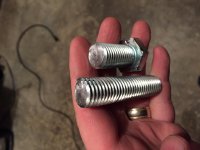
The sacrificial bolt made the ultimate sacrifice. I finally got the anchor up to 1/4 from the top and decided to call it quits. The sacrificial bolt broke when I was removing it. None of my area stores have this kind of tap bolt in a high grade (or high grade threaded rod) so I'll be ordering some online.

The arm lock gears do not mesh at the lowest position. Is this design intentional, or should I cut an inch or so off of the metal pins so that I can lock the arms in place before the lift engages?
 

Attachments

  • IMG_1478.jpg
    IMG_1478.jpg
    141.5 KB · Views: 166
  • IMG_1448.jpg
    IMG_1448.jpg
    133.9 KB · Views: 169
Last edited:

Denwood

Well-known member
Joined
Sep 22, 2014
Messages
4,180
Location
Thunder Bay, Ontario, Canada
That is by design. The idea is that the locks disengage when the vehicle is lowered so you can swing the arms out of the way. It happens in the last inch or so of travel. For this reason, you should always check and make sure they are properly engaged after lifting a few inches.
 

Acuratechva

Well-known member
Joined
Mar 4, 2013
Messages
438
Location
Virginia Beach VA
Hey guys, so like many others i've pulled the trigger and got it coming. Finally looking forward to taking on all side work. Before a jack stand clutch was..."**** that, aint worth it" kid of deal.
Anyway, EPoxy anchors is what i plan to go with. My current slab is 4-5" inches so no problem....technicaly.

Many have pointed out that epoxy may and will ooooze out blow the slab since those anchors pretty much require a through hole (especialy on 4" slab)

Ok so hear me out, i am proud to say i have read every damn page lol. Tell me if what i propose is bad and if so in waht way.


On a thin-ER slab 4-6" a through hole two things will happen.
A> Stuffed cofee filter will keep the epoxy from being pushed below the slab surface UNTIL the end of the anchor pushes/penetrates the filter or whatever object you stick there. At which point part of epoxy will stay and part will escape, i see no other way.

B> Alternative i am proposing/questioning is to shorten the anchor(grind end off) to avoid a "through hole" thus not loosing any epoxy down below. After all very tip is not providing any support if its just down in the dirt.

C> so to compare the two options we have, potential partially epoxied full size anchor, vs properly epoxied shortened anchor.

Somebody did calculations on the loss in strength and came up with something like 14000lbs, different post but i am sure some will remember.

Comets?
 
Last edited:

shortykorte

Well-known member
Joined
Sep 1, 2014
Messages
8,034
Location
Tallahassee, Fl
Out of the two, I would NOT alter the anchor. Others have done the stuffing at the bottom and if the epoxy creates an upside mushroom under the concrete, all the better right?

Properly epoxied "shorten" anchors would not be "properly" expoxied, IMHO.
 
Last edited:

Acuratechva

Well-known member
Joined
Mar 4, 2013
Messages
438
Location
Virginia Beach VA
Thanks for the input , mushrooming makes sense. Being generous with epoxi should do the trick. I got these just in case anticipating few issues.


Those that have run of epoxi, what has been a good substitute available at HD and such, if any.

MaxJax quoted 50$ for an extra tube of expoxi, which seems quite ridiculous if you ask me.
 

jrj3rd

Well-known member
Joined
Aug 20, 2005
Messages
139
Location
Severna Park, Maryland
The arm lock gears do not mesh at the lowest position. Is this design intentional, or should I cut an inch or so off of the metal pins so that I can lock the arms in place before the lift engages?

The arms should not lock until the lift begins to move upward. Do not trim them
 
Joined
Jan 12, 2015
Messages
17
Location
NC
Thanks for the input , mushrooming makes sense. Being generous with epoxi should do the trick. I got these just in case anticipating few issues.


Those that have run of epoxi, what has been a good substitute available at HD and such, if any.

MaxJax quoted 50$ for an extra tube of expoxi, which seems quite ridiculous if you ask me.

I'm assuming you're using Inject-TITE AWF epoxy with Power-Sert Anchors...otherwise you're on your own. Maxjax has similar procedure notes in their epoxy grip kit. Their kit is a good value instead of buying anchors, epoxy and nozzles separately: http://www.maxjaxusa.com/buy-purchase-maxjax-car-lift/epoxy-grip-anchor-bolt-kit.html
BUt if you just need another tube of epoxy:
http://fasteners.stanleysupplyonline.com/viewitems/hors-accessories-inject-tite-formula-epoxy-anchors/-epoxy-anchors-inject-tite-awf-all-weather-formula
You can get the 9 oz tube for considerably less and it fits a normal caulk gun. The larger size, 28 oz, requires a specialized 10:1 dispenser that costs at least $70. Make sure you get the proper mixing nozzles - you'll need several:
http://fasteners.stanleysupplyonline.com/item/-adhesive-anchors-accessories-adhesive-accessories/ries-adhesive-accessories-break-off-mixing-nozzles/enz38?.

I also drilled through my slab (even though 6" thick) and used a foam disc approx 1-1.25" diameter to act as a dam and prevent drainage of the epoxy - (it's pretty watery before it sets up).

Basic procedure (my procedure):
1) Drill hole, wirebrush hole walls by hand (use wire bristle brush - toothbrush type is best unless you can get a wire bottle brush). Vacuum hole, brush again, then use a slender nozzle at the very bottom and blow out with compressed air (COVER YOUR EYES!) - you'll not believe how much dust still comes out even after vacuuming. Repeat brush and air blow two more times. Repeat for all the other holes. If your hole is wet, you cannot epoxy until it is dry - make sure any water under the slab and affecting your holes is removed before starting any cleaning.
2) Test fit each anchor in each hole to installation depth - use a bolt screwed into the anchor to allow extraction (use a prybar as a lever on the bolt head and something to protect your floor). It should be a tight fit -not a drop-in - there should be some friction when inserting. Make sure you can insert it fully - use a mallet if necessary. Remember that if you can't get it in now, it'll never go in with epoxy later.
3) If a hole is too tight even after using a mallet, lightly run the masonry drill (I used a Bosch SDS Plus bit) in the hole to increase its diameter, check and repeat if necessary, Re-clean the hole.
4) After loading up the caulk gun and nozzle and expelling the epoxy so it has a consistent gray color (check the nozzle to see how the mix goes), insert the foam disc into the hole - push it to the bottom with the anchor then remove anchor. Fill the hole halfway with epoxy. Thread bolt into anchor and insert into hole with a twisting motion to installation depth. If epoxy oozes up (and you should get some around the circumference of the anchor), the bolt will keep the anchor threads free of epoxy. Once anchor is to depth, wipe epoxy from top of anchor, remove bolt.
5) Repeat for remaining holes.
6) Let cure - it says a few hours for complete cure depending on temperature.
7) Test. Once fully cured, you need to test the anchors. I set up like so and tested it with a torque wrench to 100 lb-ft.
8) If a failure, then wrench the anchor out. Use your drill to drill out the remaining epoxy and repeat procedure above.
 

Attachments

  • Epoxy Anchor Test.jpg
    Epoxy Anchor Test.jpg
    59.8 KB · Views: 134
Last edited:

Acuratechva

Well-known member
Joined
Mar 4, 2013
Messages
438
Location
Virginia Beach VA
ochristofferson, i could not hope for a better walk through and the links. This will have me fully prepared when it finally comes! Thank you!


On a different note, i have a 1/4" *(at least) thick race deck type of floor. If i pull out a couple of tiles just for the lift columns they will drag on the floor wont they?
 

Mr onetwo

Well-known member
Joined
Apr 6, 2011
Messages
2,002
Location
Coastal Maine
Thanks for the input , mushrooming makes sense. Being generous with epoxi should do the trick. I got these just in case anticipating few issues.


Those that have run of epoxi, what has been a good substitute available at HD and such, if any.

MaxJax quoted 50$ for an extra tube of expoxi, which seems quite ridiculous if you ask me.
From personal experience, you will absolutely need at least 1 and probably 2 extra tubes of Inject-tite. My slab is more than 6" thick and all the holes were exactly the right depth with no blowout. I only got 7 anchors out of the 2 tubes supplied!:sad:
 
Joined
Jan 12, 2015
Messages
17
Location
NC
ochristofferson, i could not hope for a better walk through and the links. This will have me fully prepared when it finally comes! Thank you!


On a different note, i have a 1/4" *(at least) thick race deck type of floor. If i pull out a couple of tiles just for the lift columns they will drag on the floor wont they?
Thanks!

Not sure what you mean by dragging on the floor.
If you have the posts mounted in a recess (like removed tiles) then the lift arms may drag - but they'll drag even when not in a recess. Mine will drag if I let them down fully - I just stop before they actually contact the floor. As long as they clear the undercarriage of your vehicle (so you can swing them in and out), you'll be fine. My floor has some slope as well as unevenness so I have to make sure they don't actually drop completely otherwise they'll scratch my nice epoxy floor coating.

One thing you may want to consider (after finding out the hard way) is to bevel or round the bottom edges of the post bases on all 4 sides. That edge will dig into your floor when tilting the post to move - rounding it (use a metal grinder) to a nice curve instead of a sharp corner will do the trick. It doesn't need to be much of a curve - even a 1/4" radius will do the trick. This may not be much issue on a softer surface like tiles but will show on harder floors. Make sure you do all 4 edges - when positioning the post, you'll likely tilt it slightly one way and another - so rounding those off prevents any "digs".
Enjoy!
 

AG1LE

Member
Joined
Dec 11, 2015
Messages
11
Location
Kansas City Area
Today I finished installing anchors for one post. My garage floor was thick enough but isn't level, so I needed to use the maximum number of shims (4) on one side. Now the post is level (enough), but now I have a large gap under the inside of the plate (see picture).

That gap makes me nervous.

Does anyone else have this kind of gap on the inside of the bottom plate, and did you use shims under the inside of the plate for added support? Any issues?
 

Attachments

  • FullSizeRender 53.jpg
    FullSizeRender 53.jpg
    143.6 KB · Views: 178
Joined
Jan 12, 2015
Messages
17
Location
NC
Today I finished installing anchors for one post. My garage floor was thick enough but isn't level, so I needed to use the maximum number of shims (4) on one side. Now the post is level (enough), but now I have a large gap under the inside of the plate (see picture).

That gap makes me nervous.

Does anyone else have this kind of gap on the inside of the bottom plate, and did you use shims under the inside of the plate for added support? Any issues?
I don't have that much - only about 1 washer on 3 of 5 anchors.
Because this gap is fairly substantial, you might want to consider getting someone to fab a steel plate at that thickness with through holes for the bolts. This could take the place of the washers and give you some confidence in the post footing. The plate should run under the complete length of the side with the washers so it could be a simple steel slat. The base plate is fairly substantial and can support a span easily.
You might also consider slightly longer bolts to compensate for the decreased engagement in the anchors themselves.
Just my 2 cents.
 
Last edited:

Denwood

Well-known member
Joined
Sep 22, 2014
Messages
4,180
Location
Thunder Bay, Ontario, Canada
Today I finished installing anchors for one post. My garage floor was thick enough but isn't level, so I needed to use the maximum number of shims (4) on one side. Now the post is level (enough), but now I have a large gap under the inside of the plate (see picture).

That gap makes me nervous.

Does anyone else have this kind of gap on the inside of the bottom plate, and did you use shims under the inside of the plate for added support? Any issues?

You could use a grout product to fully support the columns, but keep in mind that pad leveling is more important than column leveling. With the lift arms/pads lowered and rotated to center, do the left pads match up to the right pads?

Pad leveling vs column leveling:
http://www.garagejournal.com/forum/showthread.php?t=303644
 

52wrench

Well-known member
Joined
Dec 20, 2015
Messages
69
Location
western NYS, land of taxes
Today I finished installing anchors for one post. My garage floor was thick enough but isn't level, so I needed to use the maximum number of shims (4) on one side. Now the post is level (enough), but now I have a large gap under the inside of the plate (see picture).

That gap makes me nervous.

Does anyone else have this kind of gap on the inside of the bottom plate, and did you use shims under the inside of the plate for added support? Any issues?

Take some 1/2" washers and use them on the inside edge. If they aren't the right thickness for a tight fit cut some sheet metal shims to make up the difference. The plate isn't going to bend if it isn't entirely supported underneath but you don't want a soft foot on an inside corner, that will put more tensile load on the anchors under load.
 

AG1LE

Member
Joined
Dec 11, 2015
Messages
11
Location
Kansas City Area
Thanks everyone for the advice.

I will wait until I have the other post installed and then factor in pad leveling before I finalizing my shim setup. A corner support (like the thick washers, instead of a solid plate along that entire side) would work best for the post I already installed, since each corner requires a slightly different shim height to get it level (and I don't have a good way to make a graded steel plate). I'll see if that's still the best option after I account for pad leveling.
 

NedNorton

Well-known member
Joined
Jul 14, 2012
Messages
608
Location
Colorado, USA
There is so much info on this thread, and it was very helpful in my install :bowdown:, I thought I would put in my .02 and hopefully help out the next guy.

Conditions:
Slab is steel reinforced and 6”+ with radiant tubes. (I missed with all the holes!)
9.5’ ceiling height

Install:
Posts installed 130” apart
Started with the friction anchor set – Finished with the epoxy anchors

Vehicles:
BMW E90
BMW E46
1974 Chevy K20

Impressions and suggestions:

130” is about perfect for the vehicles that I have to get on the lift. Any tighter and the arms would have a hard time getting to the lift pads on the BMWs, any farther would be a big stretch for the truck. The BMWs can go the full height of the lift. The truck can almost make it. If I change the opener to a side mounted unit I think the truck will clear.

Anchoring system – I had mixed results with the supplied friction anchors (some would bite, some would not :headscrat) and would recommend that folks purchasing the lift opt for the epoxy version. I wish that Danmar would give the option of selecting the epoxy anchors in lout of the friction set. I also found that you will need an additional tube of the epoxy if you plan to go that route.

I replaced the supplied quick disconnect fittings with the aftermarket one’s detailed in this thread. I gave the stock ones a try and, like others, found them to leak. In addition I have replaced all the fittings on the hydraulic cylinders due to leaking. Replacing the anchors and fittings added a few hundred to the cost of the lift. :( The fill hole for the hydraulic fluid is really small. It is less than an inch. I bring this up so that while you are buying the ATF make sure to get a suitable funnel.


In the last week I have put it through the first of many car repairs to come and I have say; Once set-up and sorted, it is everything that it advertises to be. Quick to go up, quick to take down and it allows those of us without the dedicated space or headroom to get off jack-stands and up to a much more comfortable working level. (please excuse the floor, we live on a dirt road)


All and all, it is a great product and a welcome addition to the garage. Now to figure out how much metal slat-wall I need to get it stored properly (Credit to Woody for the terrific idea.) :thumbup:
Cheers,
Chris
 
To avoid these ads, REGISTER NOW!

jsballou

New member
Joined
Aug 28, 2012
Messages
3
I have had my MaxJax for 5 years now and can't be any happier with it. I have had a lot of ups and downs with it. It has moved with me to two houses.

Old House set-up:

nofront.jpg


dirty.jpg


2014-10-17-11-16-10.jpg


2013-08-03-13-28-31-custom.jpg


naturalstate1.jpg


It even lifted my Ford Flex (which was at the suggested Max lifting)

flexlift.jpg


Now at my new place. Just installed it a few days ago.

maxinstalled-1.jpg


maxinstalled.jpg
 
Last edited:

Cue

Well-known member
Joined
Jul 25, 2013
Messages
291
Location
Zebulon, NC
I was thinking about buying a Ford Flex, looks like the weight is 4400-4800 pounds which is under the 6000 pound limit of the Maxjax, why do you say its at the limit?

I see you have your lift mounted right next to the joints in the concrete, Maxjax says to keep the bolts at least 6" away from them, any cracking?


I have had my MaxJax for 5 years now and can't be any happier with it. I have had a lot of ups and downs with it. It has moved with me to two houses.


It even lifted my Ford Flex (which was at the suggested Max lifting)

flexlift.jpg


Now at my new place. Just installed it a few days ago.

maxinstalled-1.jpg


maxinstalled.jpg
 

jsballou

New member
Joined
Aug 28, 2012
Messages
3
Your right, it is at or around 4800lbs. For some reason I thought it was in the 5K range. (Maybe with all my stuff in the car it is.) I never had any issues with cracking. When I first drilled the holes, I started with a regular drill and slowly started the holes with a new Bosch 7/8" mason bit. When I felt the hole was deep enough, I switched over to the Hammer drill. First house, Concrete was 4.5' thick, second house, one side was around 6", the other side around 5". I also used epoxy at each location for the added protection.
 

Bill-banger

Active member
Joined
Mar 22, 2014
Messages
35
Location
Fort Payne, AL
I've been reading that the uneven lifting of the two sides of our MaxJax can be attributed to leaking quick couplings, which allow air to enter despite the best bleeding efforts. I'm wondering if this is my problem, as I continue to have one side lag the other(almost always the same side). I'd like to get some better couplings, and have seen some links here to ordering online, and also that some have found replacements at Tractor Supply. Can someone give me the specs on what I need? I think they are 3/8" but the female connector on the coupling at the base of the post looks to be bigger in diameter than the female end of the one on the end of the hose, so I'm wondering if I need a mismatched pair? I know I can take them off and get the right measurements, but I'd like to have the right parts in hand before I take the old ones off.
 

shortykorte

Well-known member
Joined
Sep 1, 2014
Messages
8,034
Location
Tallahassee, Fl
Did you pour a pad? If so I have a question.

Did you hand mix the concrete, use a mixer or have it delivered? According to the Quikrete site, each 4x4x1 pad will take 28 bags(80#).
 

RAYJAY

Well-known member
Joined
May 29, 2006
Messages
2,638
Location
UNION DALE PA

Attachments

  • DSCF6911 (Medium).jpg
    DSCF6911 (Medium).jpg
    127.2 KB · Views: 198
  • DSCF6910 (Medium).jpg
    DSCF6910 (Medium).jpg
    115.4 KB · Views: 182
  • DSCF6902 (Medium).jpg
    DSCF6902 (Medium).jpg
    134.8 KB · Views: 209

Denwood

Well-known member
Joined
Sep 22, 2014
Messages
4,180
Location
Thunder Bay, Ontario, Canada
I've been reading that the uneven lifting of the two sides of our MaxJax can be attributed to leaking quick couplings, which allow air to enter despite the best bleeding efforts. I'm wondering if this is my problem, as I continue to have one side lag the other(almost always the same side). I'd like to get some better couplings, and have seen some links here to ordering online, and also that some have found replacements at Tractor Supply. Can someone give me the specs on what I need? I think they are 3/8" but the female connector on the coupling at the base of the post looks to be bigger in diameter than the female end of the one on the end of the hose, so I'm wondering if I need a mismatched pair? I know I can take them off and get the right measurements, but I'd like to have the right parts in hand before I take the old ones off.

The flow divider is not perfect..so a difference of 1.5" is considered within spec . Swap your lines left to right..my guess is that the behavior will "follow" the lines.
 

AG1LE

Member
Joined
Dec 11, 2015
Messages
11
Location
Kansas City Area
All of my anchors seem to have grabbed, and I didn't have any concrete thickness issues at the chosen post locations (didn't hit the bottom of the slab even at 7 inches or so in one case). I consider myself lucky for that part (assuming the anchors continue to hold when under load).

I started by independently leveling each post (nearly) using shims. I confirmed that the distance between the posts is the same from top to bottom.

Now to focus on leveling pads.

Initial measurements were taken this way
- using a 4' level
- from pad center to pad center (all measurements taken at 4' distance)
- arms extended at approximately the same angle for each Set of measurements
- arms at the lowest setting and fully extended

Set 1. Between pads on the same post: front pad about 3/16" higher than rear pad for both left and right posts (I had to adjust the right post slightly out of level to reduce the right side pad height difference and achieve this consistency).

Set 2. Between the two front pads and between the rear two pads: right pad about 3/16" higher than the left pad, for both the front and rear sets of pads (after the adjustment mentioned above).

Next I plan to get the hydraulics working and measure the distance between pads (when fully extended toward each other) at the highest and lowest positions. If these are consistent, then I think I'm done - does that sound right?
 

rich g

Member
Joined
Aug 14, 2008
Messages
23
I wanna get one of these so bad but I'm afraid my garage is too short. At the lowest point with the garage door open I'm just shy of 8'. For you guys that use these with success, how low is your garage door when open?
 

Acuratechva

Well-known member
Joined
Mar 4, 2013
Messages
438
Location
Virginia Beach VA
Hey Guys, may be an obvious question but.....i got my anchors(separate from max jax, it has yet to arrive) and the botls are not there.....Only the anchors(injectite) in the box, no bolts. Seems pretty strange. Does this sound right to anyone?

I know this is something to ask Dunmar but much to late and ia m a bit worried of upcoming hassle to source bolts...
 

nholmes

Active member
Joined
Apr 29, 2015
Messages
40
Hey Guys, may be an obvious question but.....i got my anchors(separate from max jax, it has yet to arrive) and the botls are not there.....Only the anchors(injectite) in the box, no bolts. Seems pretty strange. Does this sound right to anyone?

I know this is something to ask Dunmar but much to late and ia m a bit worried of upcoming hassle to source bolts...

My anchors did not include bolts, I just used the ones that came with my MaxJax.
 

Serj_DMR

Member
Joined
Mar 4, 2015
Messages
22
Location
Simi Valley, CA
Hey Guys, may be an obvious question but.....i got my anchors(separate from max jax, it has yet to arrive) and the botls are not there.....Only the anchors(injectite) in the box, no bolts. Seems pretty strange. Does this sound right to anyone?

I know this is something to ask Dunmar but much to late and ia m a bit worried of upcoming hassle to source bolts...

Acuratechva,

The supplied bolts that came with the unit originally will work with the epoxy anchor replacements. You already have everything you need! Let me know if you have further questions or concerns by calling in and asking for me.

-Serj
 

nefkntym

Active member
Joined
Apr 9, 2014
Messages
26
Location
Colorado
Your right, it is at or around 4800lbs. For some reason I thought it was in the 5K range. (Maybe with all my stuff in the car it is.) I never had any issues with cracking. When I first drilled the holes, I started with a regular drill and slowly started the holes with a new Bosch 7/8" mason bit. When I felt the hole was deep enough, I switched over to the Hammer drill. First house, Concrete was 4.5' thick, second house, one side was around 6", the other side around 5". I also used epoxy at each location for the added protection.

I know you from Audizine. Seeing you install on Audizine helped with my decision on picking up a Maxjax. Like you, I am on my second install of it in a new house.
 

Acuratechva

Well-known member
Joined
Mar 4, 2013
Messages
438
Location
Virginia Beach VA
Acuratechva,

The supplied bolts that came with the unit originally will work with the epoxy anchor replacements. You already have everything you need! Let me know if you have further questions or concerns by calling in and asking for me.

-Serj

Serj, thank you. I was just jumping the gun, since two of those arrived apart from each other. Too anxious:shocking:

Thanks for making it happen on the last maxjax in the us...till next load that is haha. You guys are awesome.
 
Last edited:

Acuratechva

Well-known member
Joined
Mar 4, 2013
Messages
438
Location
Virginia Beach VA
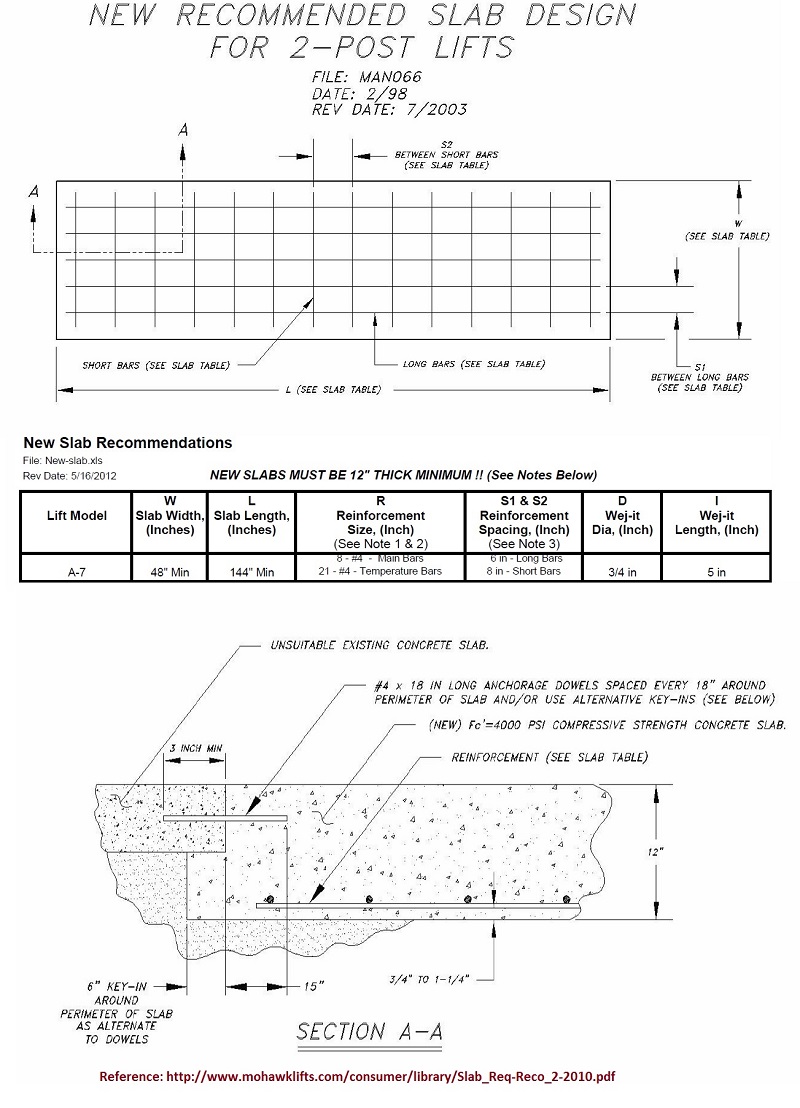
Spec, my personal thoughts after doing a bit of research, was to use epoxy, and re pour to get correct depth. It wasn't a ton of work, but the peace of mind is excellent :) I used the mohawk spec as below, and parsed out the essentials.

Stratojet, my suggestion for the carport would be a 4'x12' reinforced slab, 12" thick, undercut at least 6" to the existing pavement. I ran some numbers on this scenario and calculated that it would require a 1000 lb mass, hanging from your average 14ft long car bumper, to tip a slab like this (assuming a free standing slab) Because the surrounding pavement will offer less strength at the edges, the sheer weight of this slab will give you a good safety factor. I'm not an engineeer, just going by Mohawk's recommendations and simple force/lever calcs.

http://mohawklifts.com/library/manuals/Slab_Require_Recommend_11_07.pdf

mohawk_slab.jpg


Am i seeing it right that the reinforcement is at the very bottom on the flab, less than two inches? Whats the engineering aspect behind it, i would think center would make more sense.
 

RAYJAY

Well-known member
Joined
May 29, 2006
Messages
2,638
Location
UNION DALE PA
Am i seeing it right that the reinforcement is at the very bottom on the flab, less than two inches? Whats the engineering aspect behind it, i would think center would make more sense.

middle would be PIA just for drilling, and when you tie all of the rod together that makes your strength, you have 11" of crete plus the solid rod mass on bottom of pad everything below the rod has no structure to it,

think of it like a car frame
 

Mr onetwo

Well-known member
Joined
Apr 6, 2011
Messages
2,002
Location
Coastal Maine
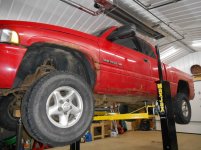
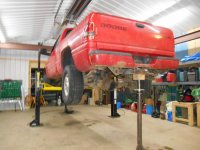
My latest vehicle to go up on my MaxJax. I timed myself in setting it up....20 minutes start to finish.Not bad for a guy in a wheelchair!:thumbup:
 

Attachments

  • DSCN1276.jpg
    DSCN1276.jpg
    140.5 KB · Views: 211
  • DSCN1277.jpg
    DSCN1277.jpg
    132.4 KB · Views: 268
  • DSCN1279.jpg
    DSCN1279.jpg
    140.9 KB · Views: 199
To avoid these ads, REGISTER NOW!
Top Bottom