drives
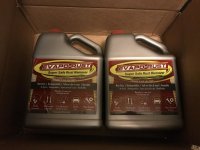
Potency of Evaporust or Metal Rescue (a second water-based, non-toxic, acid-free, Ph-neutral chelator on the market for a few years now) is hard to determine. The duration of the potency is not. It is directly proportional to the surface area of the steel that is immersed in it and the duration of the immersion. Picture the microscopic view. Thousands of chelator molecules attaching to thousands of oxidation molecules and loosening them. Those chelator molecules turn the color of rust and are no longer active. As you introduce new rusty tools to your solution, the solution gets darker and darker. That is the rust being removed, as inactive molecules start to outnumber the active molecules. Eventually, there are no active molecules left, or so few, that a rusty tool will emerge still rusty no matter how long it is immersed. Everyone's "experience" with the duration is subjective, because there is no way to know how much rusty steel each of us is immersing and for how long without measuring that.
The only way to make Evaporust or Metal Rescue seemingly* "last longer" is to preserve the active molecules. There are only two ways to do that: (1) reduce the amount you use from the original container to the bare minimum required for tool immersion, and (2) try to separate the inactive molecules from the active molecules (i.e., filtering).
I was doing both for over a year or so.
My methodology...
I know some guys use different shaped bins for different size tools, but I have one bin, which seals tight, that I prop up with blocks in different directions (lengthwise, or on end) based on the size of the tool. Either way, you only want to use the minimal amount you need to fully immerse the tool, and no more. When I pulled that tool out, I did not pour that used solution back into the container with the unused solution. I poured it into a separate container, and I poured it through a very fine mesh screen filter. I re-used that used solution for the next rusty tool. Again, I only used the minimal required amount. If the size of the tool required more solution for the tool to be fully immersed, only then did I add more solution from the original unused solution container, and only just enough to fully immerse the new rusty tool, and no more. Only when that used solution was fully spent (again, criteria is rusty tool emerges rusty after a few days...) did I dispose of it. So I was constantly filtering and controlling the amount of used solution and the amount of new solution added to the used solution. One bin, two containers (original and second), one fine mesh filter.
I stopped filtering about a year ago just to see what would happen. The difference was so negligible in terms of the duration, and then Tractor Supply dropped the price from $21 to $17, so I have not gone back to filtering. I still control the immersions to preserve the used and unused solution. But I no longer bother filtering.
*Technically you cannot and are not doing anything to change anything at the molecular level. You're only controlling the immersion.
(I know I have described my methodology before, but I can't seem to find it. It seems that no matter what we do to try to reduce it, we still have this propensity for redundancy here on GJ. And here I am contributing to it! Links to many various prior 'Tool Cleaning' and 'Rust Removal' threads are in the Index in the Sticky, post #3, if anyone is interested.)






 to what macgee said.


![IMG_4693[1].jpg](/forum/data/attachments/971/971797-c729fd9eada106f291b646c979d1baf3.jpg)
![IMG_4686[1].jpg](/forum/data/attachments/971/971788-ec9b01200c99bc9c45d50ff303b7c467.jpg)
![IMG_4684[1].jpg](/forum/data/attachments/971/971777-d20c99ce56ad70056d5da58013e4a54e.jpg)



 )
)