Thanks for posting this. Interesting stuff. Surprised at the Snap on open end results. I wonder if the breakaway results leaderboard would be in the same order across all spanner sizes or if some spanner designs scale down to the smaller sizes better than others.
Deen does very well showing that Taiwan made tools can compete with the best of them. Test wasn't done by Factory Gear was it?

Being a destructive test only, we don't know what the long-term durability is. If a tool's merit is decided based on outright breakaway numbers, then manufacturers should be able to adjust their steel alloy composition and heat treating methods to reach higher numbers. But that's not the case.
Manufacturers want to know how their tools peform under repetitive, long-term use as well, when operated within their workable work loads. Such testing would take hundreds of hours to conduct to do a comparative study between different brands.
The testing was done by Factory Gear. That may immediately raise alarm flags, calling the testing to be rigged or biased in favour of their in-house brand, DEEN.
I should point out that Factory Gear, from their inception, have been promoting the spread of the world's finest tool brands to Japanese consumers. Some are better represented than others, but they offer many reknowned tool brands from Europe and Japan, not to mention some Snap-on...and even King Tony (Taiwan). There aren't many tool stores in this world that provide that level of variety under one roof.
In their corporate/social media advertisements, they constantly promote non-DEEN branded tools.
So, DEEN tools are, for the most part, made in Taiwan. As we all know it, many tool manufacturers, whether it be American, Japanese, or European, have been working together with Taiwanese tool manufacturers/OEM/ODM's because they see what some of these companies are capable of producing. I know that there are other factors involved, but my point is I think the major key players in Taiwan have proven their worth to their clients. We can't deny that consumers have noticed the quality in the product as well.
Thanks for reminding me of that post, and for posting it in the first place
With those results on the box end, I would say that the poorer open end results are from a slimmer design. And that they have chosen a softer hardening, probably with "bend before breaking" in mind.
There were two KTC wrenches tested. The one that pulled the higher number is their standard one, while the other one is a thin-profile wrench (probably the thinnest one in the test).
Factory Gear's president has pointed out in the past that tool manufacturers value these findings as they can compare how others performed in relation to their own. Not necessarily in terms of breakaway numbers, but how they bend/break and at what angle that took place. Tool companies take operator safety in mind and engineers are keen on knowing how and when things bend/break.
Seen that before, but still interesting!
I’m not surprised that the winners are Snap On and Nepros, if you had asked me to name the two best wrench manufacturers worldwide, that’s who I would have picked!
I’m a little surprised that the Flank Drive open end outperformed the Flank Drive Plus, but you don’t know what hardness of fastener you were dealing with. I suspect the fastener hardness, and size, chosen were the ones that the Deen performed best on...!
Interesting that the open end of the Hazet was up there with the best, but the Stahlwille was some way behind. Rather confirms what mr.lemons found.
In reality of course, I use the open end of a combination wrench rarely, and when I do I seldom need high torque. One thing I do notice from the test, is that when you look at the box end results, there isn’t so much difference, and all but the cheapest seem to perform reasonably well!
Yes! The performance you get in terms of shear strength is pretty remarkable as they far surpass the minimum DIN standard requirements!
I should note that the various testing performed was done in cooperation with various tool manufacturers in Japan (socketry maker, pliers maker, screwdriver maker, hex key maker, etc.).
As far as the test rig for the wrenches...the device likely uses an expensive, high-grade hex stock that's hardened appropriately. Here's a photo...look at "test 2"
<a data-flickr-embed="true" href="https://www.flickr.com/photos/ccassan/26219542844/in/photostream/" title="Factory Gear Magazine 143"><img src="https://live.staticflickr.com/7164/26219542844_d395aa9007_h.jpg" width="1163" height="1600" alt="Factory Gear Magazine 143"></a><script async src="//embedr.flickr.com/assets/client-code.js" charset="utf-8"></script>
Missed that as I don't know Snap on part numbers very well. Looks like the 'plus' doesn't make much difference at all really. From the pics it look like they used some sort of hex stock in place of a fastener.
FD+ makes a huge difference. You can basically put a wrench on a bolt and stand on it without it slipping. Only thing I can think is their control hex was hardened so much it made the teeth pointless. Either that or they were clamping all the open ends shut from the outside to force breakages and permanent damage rather than spreading but FD+ compared to a normal open end is day and night difference.
Yup, the FD+ really grabs/bites. I've bought a couple sizes for one purpose in mind -- dealing with stubborn/marred up tie-rod ends. There really is a difference.



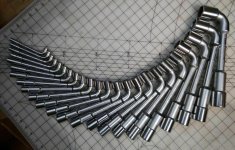
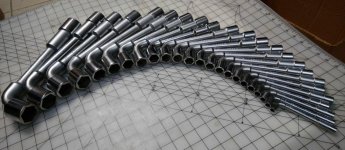
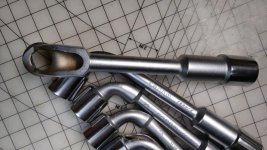

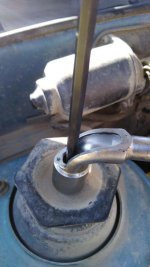





 And im not guessing


