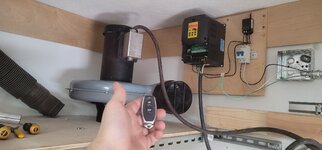
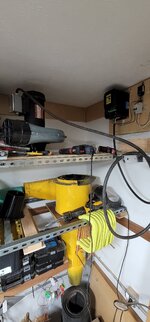
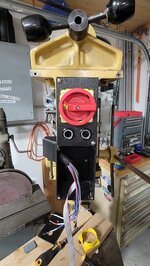
The old man use to have all of his pivots running off diesel, but over the past twenty years, he has been switching over to electric on some. He now has five pivots on electric (well and pivot), and three on diesel (with a generator for the pivot). He was split down the middle, but he switched one more this winter.
Martin
Sorry, I'm a city type. What is this "pivot" ur talking about?
[/QUOTE]
No worries and thanks for commenting...happy to share!
For a large part of the US, irrigation is used to improve crop yields just like it's used to make yards look better...this is just on a larger scale. Some areas such as Western Kansas it's either irrigate or you don't get a crop as there just isn't enough natural rainfall. Wells can be varying depths, from 75 to 100' for areas with very high water tables to deep wells that can be over 1,000 ft deep, power requirements vary based on how much you're pumping but are either done via electric motors or a gas/diesel/propane/nat gas powered engine
Flood irrigation is using a series of pipes, generally 6" or 8" diameter where we farm that have openings (we call them gates) to allow the water you pumped out of the ground to run down the rows like this:

You then get to go and open/close the gates every 8 or 12 or 24 hours depending on what you're doing. So more labor intensive but much cheaper to do. For us, we use mostly 8" aluminum pipe in 30' sticks and it gets put out after the fields planted and ready to irrigate, then you go back and pick it up before harvest. It's a pretty straight forward job as the pipe is pretty light, but ideally takes 3 people, 1 to drive the truck and 2 to pickup/put down pipe. As my brother and my available labor disappeared from the farm as we went to college etc, flood irrigation was generally replaced by pivots and now we put out 1 trailer of pipe for a little 30 acre portion of a field we can't get with the pivot system.
Pivots are the classic trade off of buying your time back with a capital purchase:
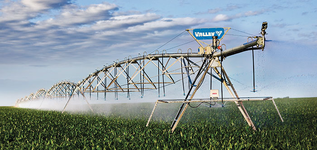
The common style where we farm is a system like this which rotates around a center base/tower, hence the name center pivot irrigation as it's pivoting around the center point. Each tower has a pair of wheels on it so it slowly makes an arc thru the field. Water is pumped up at the center pivot point, then flows thru the arched main pipe towards the end. The nozzles/spray heads then tap into that main pipe and have a calibrated head on them to put out the desired amount of water. You then control the total "rainfall amount" by how fast you run the pivot around the field...need to put more on....just slow it down....speed it up for lighter amounts. Wheel motors are generally electric and are provided that power by the discussed hookup to the grid, or by an engine power unit spinning a generator to provide the required energy.
They can be setup to based on the field layout to spin a full circle, half circle, quarter etc, just depends on what you're looking for and what arrangement gives you the best coverage and flexibility. With the proper equipment and permits you can also apply some fertilizer and chemicals with the water directly to the crops, reducing the need to run equipment thru the field.
When you fly over an ag area, the "crop circles" like shown below from a satellite shot of western Nebraska are each a location of a center pivot irrigation system. Most of these circles are watering a "quarter section" of land or 1/4 of a square mile which is 160 acres. Because of the corners you don't actually get full coverage of all 160 acres, so many people will plant a different crop in the corners that isn't irrigated. The circles shown here are each around 1,400' radius, so likely a 7 or 8 "tower" or "section" pivot

A video from Valley who is one of the major manufacturers of these give a better overview of them is here:
With the right features/options you can monitor status and control them remotely as well from a computer or smartphone and when they complete their "cycle" as you set it up they should shut down and wait till they're told to run again. When it's time to harvest you will normally clear out a spot in the field to swing the pivot into so it's out of the way, then you can go about the harvest without any issues other than watching out for the pivot tracks where the wheels go. They can get a bit deep at times and you don't want to hit those at full speed with the tractor!